This project is funded by bilateral collaboration of TUBITAK-DAAD, namely “3D-nanofibrous matrices for accelerating wound healing: harnessing Mediterranean flora for the next generation biomaterials”.
This project aims to produce three-dimensional nanofibers by integrating technology with medicinally important plants native to the Taurus Mountains in the Mediterranean region. The resulting nanofibers will be applied in wound healing applications.
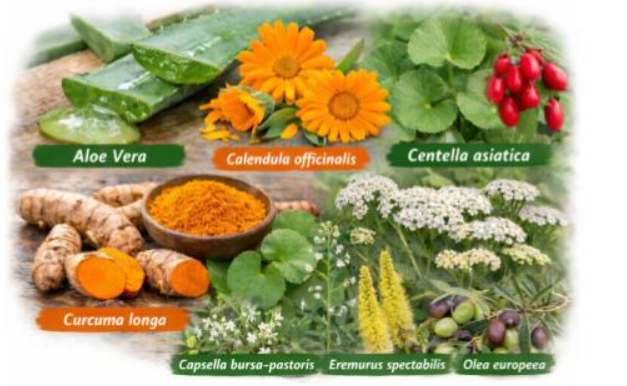
Research reviews show that many plants such as Aloe vera, Calendula officinalis, Centella asiatica, Curcuma longa, and Achillea millefolium are frequently used in herbal medicine for wound healing due to their antimicrobial, anti-inflammatory, and tissue-regeneration properties.
Recent publications, patents, and news related to this topic will be shared with you on this page.
DOI: 10.1039/D5TB00800J
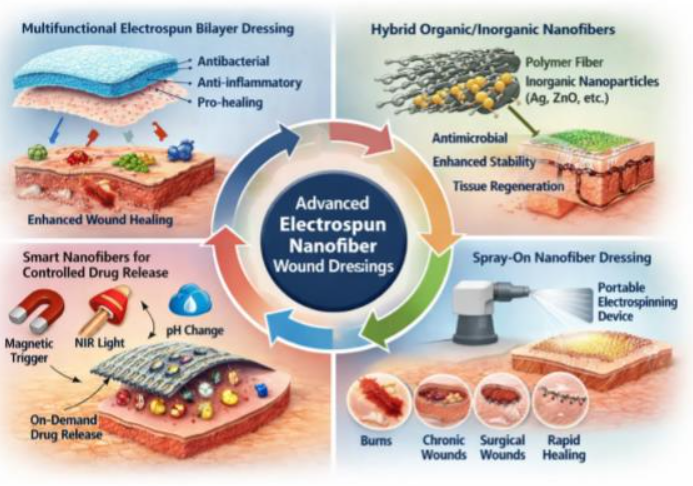
This 2025 paper reports a bilayer dressing that combines a hydrogel layer with an electrospun nanofiber layer to mimic skin architecture for infectious wound care.
The article describes a Janus/bilayer architecture with a hydrophilic Reg/PVA layer for sustained release and a PAN@TiO2 outer layer for barrier protection.
Reports about 98% wound closure within 21 days in vivo for HV/DF-loaded nanofibers, highlighting progress in pH-responsive multilayer systems.
This review focuses on sprayable nanofibre fabrication approaches such as solution blow spinning, centrifugal spinning, and spray nebulisation.
DOI: 10.1039/D4TB00149D
The study summarizes how inorganic nanoparticles are integrated into electrospun fibers to improve wound healing functions.
The upcoming events will be shared in this page.
Collaboration between leading researchers from Turkiye and Germany.
Assist. Prof.
Department of Electrical and Electronics Engineering, Antalya Bilim University, Turkiye
seda.demireltopel@antalya.edu.trProf.
Hochschule Rhein-Waal, Faculty of Technology and Bionics, Germany
Amir.Fahmi@hochschule-rhein-waal.deDr.
Hochschule Rhein-Waal, Faculty of Technology and Bionics, Germany
virajpratap.nirwan@hochschule-rhein-waal.deDr.
Hochschule Rhein-Waal, Faculty of Technology and Bionics, Germany
rebecca.hengsbach@hochschule-rhein-waal.deProf.
Necmettin Erbakan University, Molecular Biology and Genetics, Konya, Turkiye
spehlivanoglu@erbakan.edu.trAssist. Prof.
Antalya Bilim University, College of Tourism, Antalya, Turkiye
cagla.mckenzie@antalya.edu.trAssist. Prof.
Antalya Bilim University, Department of Nutrition and Dietetics, Turkiye
gulmerve.gencer@antalya.edu.trDr.
Akdeniz University, Faculty of Science, Department of Chemistry, Turkiye
Institute of Graduate Studies, Antalya Bilim University, Turkiye
2531203@std.antalya.edu.trInstitute of Graduate Studies, Antalya Bilim University, Turkiye
yusuf.aksu@std.antalya.edu.trThe publications and proceedings from this project will be listed on this page.
Please send us a message if you have any questions or inquiries about the FloFIB project.